HydraFacial & Skin Boosters: Which Is Better for Your Skin?
Posted on 14th September 2026 by Dr Yusra Al-Mukhtar
“Dehydrated skin” is often used as a catch-all term, but healthy-looking skin depends on much more than moisture alone.
Dullness, rough texture and congestion can develop when dead skin cells, excess oil and impurities accumulate at the surface. Fine lines, crepiness and reduced elasticity can reflect changes within the skin itself, including the gradual decline in hydration and structural support associated with ageing and environmental exposure.
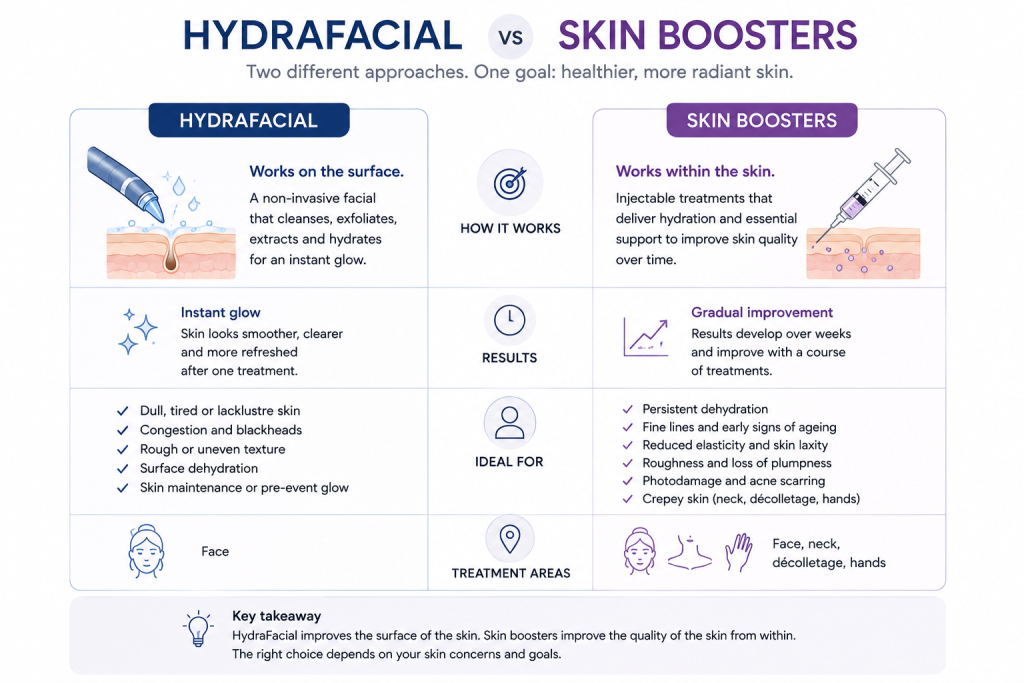
This helps explain why two treatments associated with healthier, more radiant skin can work in very different ways. HydraFacial focuses primarily on the surface, combining cleansing, exfoliation, extraction and hydration to improve clarity and texture. Skin boosters are injectable treatments designed to improve hydration and overall skin quality from within.
At Dr Yusra Clinic, we regularly assess patients with several of these concerns at the same time. Understanding what is causing the visible changes in the skin is therefore more useful than choosing a treatment by name alone.
In this guide, we explore how HydraFacial and skin boosters work, the skin concerns each can address, who may benefit from treatment and when the two approaches can complement one another.
What Does a HydraFacial Do for Your Skin?
A HydraFacial is a multi-stage facial treatment designed to cleanse, exfoliate and hydrate the skin while addressing congestion and accumulated surface cells.
At Dr Yusra Clinic, treatment includes lymphatic drainage, cleansing and exfoliation, a brightening step using glycolic and salicylic ingredients, extraction, hydration and LED light therapy.
Each stage performs a different role. Exfoliation helps remove dead surface cells that can contribute to roughness and dullness. Extraction clears debris from congested pores, while the hydration stage delivers ingredients including antioxidants and peptides to the freshly treated skin.
HydraFacial can be particularly useful for:
- dull or lacklustre skin
- congestion and blackheads
- rough or uneven texture
- surface dehydration
- regular skin maintenance
- preparing the skin ahead of an event
Because the treatment works largely at the surface and does not rely on significant tissue injury, there is typically little downtime. Patients often notice that the complexion appears smoother, clearer and more hydrated shortly afterwards.
What Are Skin Boosters and How Do They Work?
Skin boosters are injectable treatments designed to improve skin quality rather than significantly alter facial shape or contours. They use stabilised hyaluronic acid delivered through small injections into the skin. Hyaluronic acid is a naturally occurring substance with a strong ability to bind water. When used as a skin booster, its role is primarily to improve hydration, smoothness and elasticity within the treated area.
This distinguishes skin boosters from traditional dermal fillers. Although both may contain hyaluronic acid, dermal fillers are commonly used to restore volume, provide structural support or alter facial contours. Skin boosters are used primarily to improve the condition and appearance of the skin itself.
They may be considered for concerns including:
- persistent dehydration
- fine lines
- reduced elasticity
- rough or uneven skin
- loss of skin plumpness
- photodamage
- selected acne scarring
Skin boosters can also be used on areas such as the neck, décolletage and hands, where thinning, dryness and crepiness can become increasingly noticeable.
Unlike the relatively quick freshening effect associated with HydraFacial, improvements from injectable skin boosters develop more progressively.
Are All Skin Boosters the Same?
Skin booster has become a broad term for several injectable treatments designed to improve skin quality, but their ingredients, mechanisms and intended uses are not identical. At Dr Yusra we offer a range of skin boosters to meet your unique skin requirements
Profhilo contains a high concentration of hyaluronic acid and is used to improve hydration while supporting collagen and elastin. It may be considered where the skin appears dehydrated, dull or crepey, including areas such as the face, neck and hands.
Jalupro combines hyaluronic acid with amino acids. It may be considered where concerns include fine lines, reduced elasticity, dullness or sun-damaged skin.
Sunekos also combines hyaluronic acid with amino acids and may be used for dehydrated, delicate or ageing skin, particularly where fine lines and changes in elasticity are becoming more apparent.
The important distinction is that “skin booster” describes a treatment category rather than one universal product. Choosing between them requires an assessment of the skin, the area being treated and the particular changes that need addressing.
HydraFacial vs Skin Boosters: Which Is Better for Your Skin?
The main difference between HydraFacial and skin boosters is how and where they work.
When skin is generally healthy but has become dull, congested, rough or superficially dehydrated, HydraFacial may be a suitable starting point. Its different stages address several factors at the skin’s surface within one treatment, without injections.
Skin boosters become more relevant when the concern extends beyond surface condition. Persistent dehydration, fine lines, crepiness and reduced elasticity may indicate that improving hydration within the skin itself would be more appropriate.
The desired timescale also matters. Someone preparing for an event may prioritise clearer, smoother-looking skin relatively quickly. Someone experiencing progressive changes in skin quality may be better suited to a treatment where improvement develops gradually over a course.
This is why neither treatment is inherently better than the other. They address different aspects of skin health and should be selected according to the underlying concern.
Can You Combine HydraFacial and Skin Boosters?
For some patients, combining HydraFacial and skin boosters can address different layers of the same overall skin concern.
Skin rarely presents with one isolated issue. Someone may have congested pores and uneven surface texture while simultaneously developing persistent dehydration, fine lines or reduced elasticity. In this situation, HydraFacial can be used to address surface build-up, congestion and hydration, while an appropriate injectable treatment targets skin quality from within.
The treatments do not necessarily need to be performed during the same appointment. Timing should take into account the condition of the skin, the injectable product being used and any other procedures within the treatment plan.
Importantly, combination treatment should have a clinical purpose. More treatments do not automatically produce healthier skin. Each should address a specific concern that has been identified during assessment.
Do I Still Need Skincare If I Have Regular Treatments?
Yes. Professional treatments and daily skincare have different roles in maintaining skin health.
Cleansing helps remove oil, make-up and environmental debris, while moisturising supports the skin barrier and reduces water loss. Appropriate active ingredients can target specific concerns, and daily sun protection remains particularly important because UV exposure contributes to pigmentation, collagen breakdown and premature skin ageing.
This becomes especially relevant when dehydration, photodamage or uneven texture repeatedly returns between appointments. In these cases, medical-grade skincare may form part of a longer-term approach rather than relying on procedures alone.
FAQs About HydraFacial and Skin Boosters
How long before an event should I have a HydraFacial?
The ideal timing depends on your skin and whether you have had HydraFacial previously. If you are preparing for a wedding or another important occasion, discussing the date with your practitioner allows enough time to plan treatment appropriately and see how your skin responds.
Can men have HydraFacial and skin boosters?
Yes. HydraFacial and skin boosters can be suitable for both men and women. Treatment choice is based on skin condition, anatomy and the concern being addressed rather than gender.
Will skin boosters change the shape of my face?
That is not their primary purpose. Skin boosters are designed to improve hydration and skin quality rather than create the structural volume or facial contouring associated with conventional dermal fillers.
Is there a minimum age for skin boosters?
There is no single age at which someone needs to start skin boosters. Skin condition, anatomy and the changes being treated are more useful indicators of suitability than age alone.
Can I wear make-up after skin boosters?
Following Restylane Skinboosters, Dr Yusra Clinic advises avoiding make-up for the first 12 hours. Your practitioner will provide specific aftercare guidance based on the treatment performed.
How Do I Choose the Right Treatment for My Skin?
The most useful starting point is identifying why your skin has changed, rather than deciding between treatment names.
Congestion, surface roughness and a lacklustre complexion may point towards HydraFacial. Persistent dehydration, fine lines or changes in elasticity may make a skin booster more relevant. Where several concerns exist together, treatments can sometimes be introduced at different stages rather than trying to address everything in a single appointment.
At Dr Yusra Clinic, HydraFacial, skin boosters and medical-grade skincare are available with our clinical team across London, Liverpool and Manchester.
If you are unsure which approach is appropriate for your skin, book a consultation or treatment with one of our experienced practitioners. Your skin can be assessed in person so that any recommendations are based on its condition, your individual concerns and what you would realistically like to improve.

Dr Yusra Al-Mukhtar
Dr Yusra is a distinguished dental surgeon and a skilled medical aesthetic clinician with a wealth of experience in maxillofacial head and neck surgery and skin cancer surgery. She holds an impressive academic background, having graduated with first-class honours in Medical Science and Healthcare Management from Imperial College London and earned Honours and Distinction as a dental surgeon from King’s College London.Dr Yusra is a Level 7 Trainer in medical aesthetics, in line with Ofqual guidelines, and is renowned for her expertise in providing natural-looking non-surgical facelifts and a range of aesthetic treatments. Her commitment to patient well-being and safety is unwavering, making her a trusted practitioner in the field.