What Happens to Your Skin During Perimenopause and Menopause?
Posted on 8th September 2026 by Dr Yusra Al-Mukhtar

For many women, the first noticeable signs of perimenopause are not necessarily changes to their periods. They may appear in the mirror.
Skin that has always been relatively predictable can suddenly feel dry or sensitive. Breakouts may return after years of clear skin. Pigmentation can become more noticeable, while the face itself may gradually look less firm or defined.
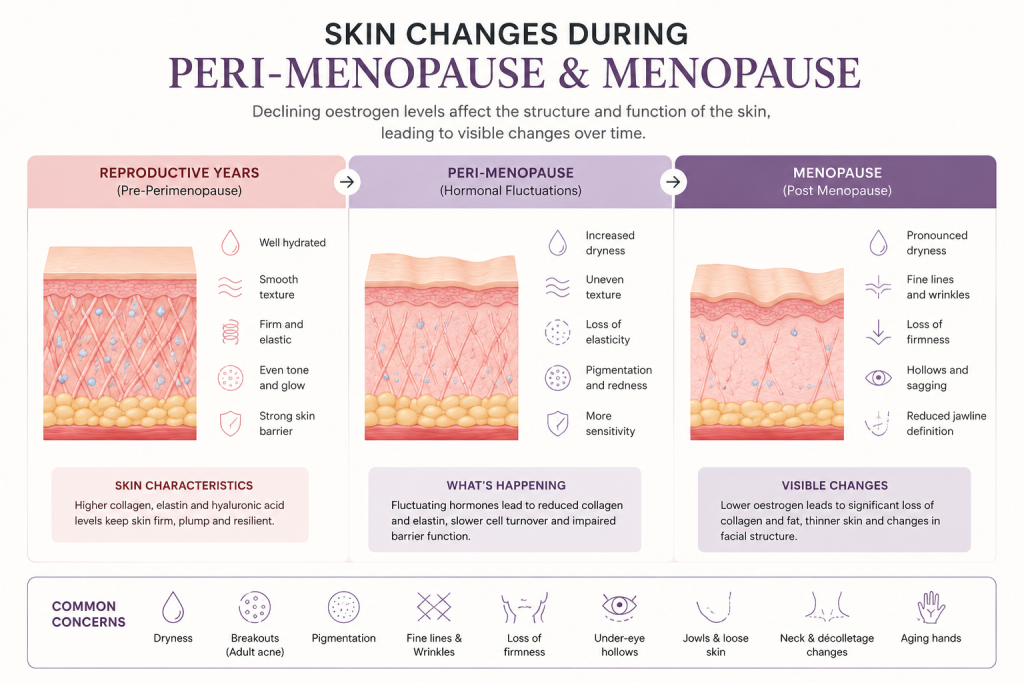
These changes are not simply a case of getting older. During perimenopause and menopause, fluctuating and eventually declining hormone levels affect many of the processes responsible for keeping skin hydrated, resilient and supported. Oestrogen is particularly important because it influences collagen, elastin, hyaluronic acid, sebum production and skin thickness.
At Dr Yusra Clinic, we often see women who feel their skin has changed surprisingly quickly during this stage of life, sometimes despite using the same skincare routine for years. Understanding what is changing beneath the surface is an important part of looking after peri-menopausal skin health and menopausal skin health properly. It also explains why the skincare or occasional facial that worked well in your thirties may no longer meet your skin’s needs in your forties or fifties.
What Happens to Your Skin During Perimenopause?
Perimenopause is the transitional period leading up to menopause. It can begin several years before periods stop completely, and hormone levels do not simply decline in a smooth, predictable line. They fluctuate. That helps explain why the skin can become unpredictable too.
Some women experience increased oiliness and adult acne, particularly around the chin and jawline. Others notice dryness, sensitivity or a sudden intolerance to products they have used for years. Pigmentation may become more visible and the skin can start to lose some of its familiar plumpness.
Common perimenopausal skin changes can include:
- dryness or dehydration
- increased sensitivity
- adult acne and congestion
- changes in pigmentation
- dullness and uneven texture
- fine lines becoming more noticeable
- gradual loss of firmness and elasticity
Not everyone experiences the same pattern. At Dr Yusra Clinic, we often see women with several concerns occurring at once. Someone may have breakouts around the lower face while simultaneously noticing dryness around the eyes and reduced firmness through the cheeks.
That is why treating “menopausal skin” as though it were one single skin type rarely makes sense.
Why Does Menopausal Skin Become Drier and Less Firm?
As oestrogen declines, the skin gradually loses some of the support that helps keep it hydrated, strong and resilient. Collagen and elastin reduce, natural hyaluronic acid levels change and the skin may produce less oil. As a result, it can become drier, thinner and less elastic.
At the same time, changes are happening beneath the skin. Facial fat can alter in volume and position, while the underlying bone gradually remodels. This is why menopausal skin changes may include several concerns at once, such as:
- dryness and increased sensitivity
- fine lines and crepey texture
- flatter or less defined cheeks
- under-eye hollows
- early jowling
- reduced jawline definition
- looser skin around the face and neck
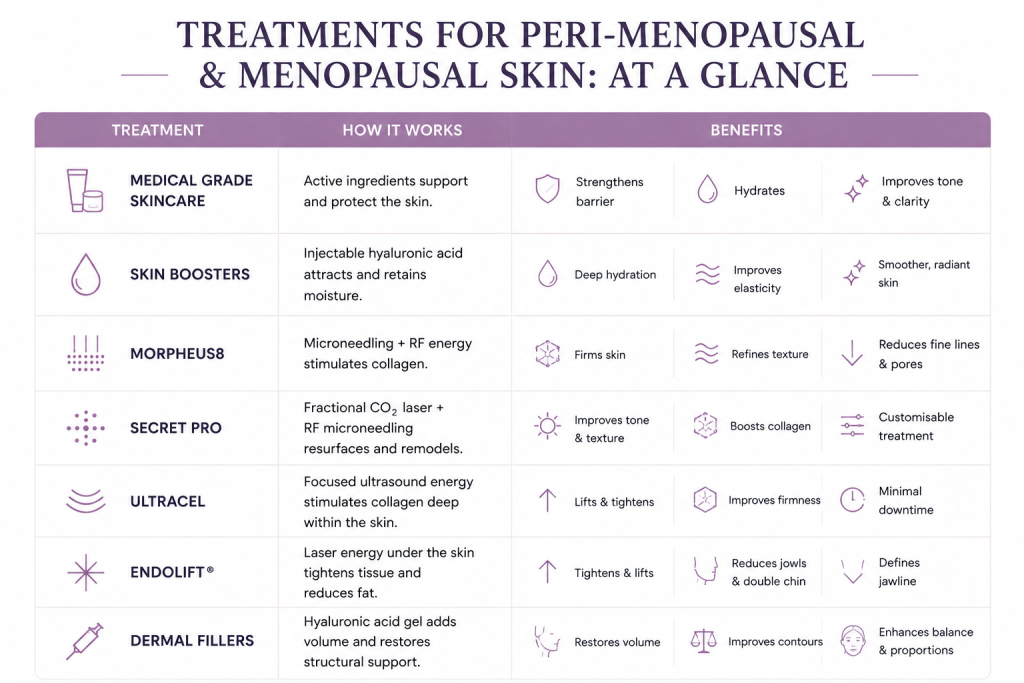
Treatment therefore depends on what is actually causing the concern. For milder dryness, we would usually start with Medical Grade Skincare, focusing on supporting the skin barrier rather than simply introducing stronger products.
Where dehydration and declining skin quality are more noticeable, Skin Boosters may be considered. These deliver hyaluronic acid into the skin to improve hydration, smoothness and elasticity, with areas such as the face, neck, décolletage and hands commonly treated.
If the main concern is established laxity or loss of facial support, however, hydration alone is unlikely to be enough. This is where we would look more closely at treatments that address collagen, tissue laxity or structural changes rather than treating every menopausal skin concern in the same way.
What Is the Best Treatment for Menopausal Skin?
There is no single “menopause facial” or treatment that addresses every change.
In practice, treatment choice depends on whether the main concern sits predominantly within the skin itself or involves deeper structural ageing.
For someone whose main concerns are dryness, sensitivity and early textural changes, Medical Grade Skincare and Skin Boosters may be appropriate starting points.
Where there is more established deterioration in texture, pores, wrinkles or firmness, treatments designed to stimulate remodelling may become more relevant.
Morpheus8 combines microneedling with radiofrequency energy. The needles enter the skin at controlled depths while radiofrequency energy creates controlled heating within the tissue. This stimulates a repair response and collagen remodelling, making it particularly useful when reduced firmness and texture are becoming more noticeable.
Secret PRO provides another approach to skin remodelling. Different Secret PRO protocols combine technologies including fractional CO2 laser and radiofrequency microneedling, allowing treatment to be adapted according to the degree of sun damage, textural change and ageing present.
These treatments are not automatically the next step for every woman going through menopause. If skin is inflamed, highly reactive or experiencing active breakouts, we would normally address those issues before moving into more intensive resurfacing or collagen stimulation.
What Can Help With Menopausal Jowls and a Less Defined Jawline?
Once the concern moves beyond skin quality into genuine tissue laxity, hydration alone will not provide the same type of correction.
This is where treatment selection becomes more structural.
ULTRAcel is a non-surgical treatment that uses focused ultrasound energy to target deeper tissue layers and stimulate collagen. It may be considered where the aim is to improve firmness and create a gradual tightening effect without surgery.
For more established lower-face changes, Endolift® may be appropriate.
Endolift uses laser energy delivered beneath the skin through a very fine fibre. It can be used to stimulate collagen, tighten tissue and address selected areas of localised facial fat. This can make it particularly relevant when jowling or a double chin involves both laxity and unwanted fat.
The distinction is important. If someone has relatively good facial structure but increasingly crepey skin, a skin-remodelling treatment may be the priority. If the jawline has become heavier because of laxity and localised fat, a treatment capable of working at a deeper level may make more sense.
Where Do Dermal Fillers Fit Into Menopausal Facial Ageing?
Dermal fillers can be useful during menopause, but they should not be viewed as the default solution whenever the face starts to look older.
As facial fat and bone support change, some women develop flattening through the cheeks, deeper shadows beneath the eyes or reduced structural support elsewhere in the face.
Carefully positioned Dermal Fillers can restore selected areas of lost volume and support facial proportions. The key word is selected. Adding filler directly into every line or area of looseness can create unnecessary heaviness. A more considered approach looks at the face as a whole and asks where support has actually been lost.
Sometimes very little filler is required. In other cases, improving skin quality or tightening lax tissue may be more appropriate than adding volume at all.
Can Menopausal Skin Treatments Be Combined?
Yes. Menopausal skin changes often occur at several levels, so a combination approach may be more appropriate than relying on one treatment alone.
For example, Skin Boosters may improve dehydration, Morpheus8 or Secret PRO may address declining skin quality and collagen, while carefully placed Dermal Fillers can restore areas of structural volume loss. Where lower-face laxity or jowling is more prominent, ULTRAcel or Endolift may take priority, supported by Medical Grade Skincare over the longer term.
Treatments are often staged rather than performed all at once, allowing us to assess how the skin and facial tissues respond before deciding what is needed next.
It is also important to look beyond aesthetics. Dr Yusra Clinic offers consultant-led Menopause Services for women experiencing wider symptoms such as hot flushes, sleep disturbance or intimate changes. Where appropriate, this may include discussion of HRT, non-hormonal options and lifestyle measures, allowing menopausal skin health to be considered as part of the wider hormonal transition.
Frequently Asked Questions About Menopausal Skin
Can menopause make rosacea or facial redness worse?
Hormonal fluctuations and hot flushes can make facial flushing more noticeable in some women. Persistent redness should be properly assessed, particularly if you are unsure whether you are experiencing sensitivity, rosacea or another skin condition.
Why has the skin on my neck changed faster than my face?
The neck has relatively thin skin and fewer sebaceous glands than many areas of the face. Changes in collagen, elasticity and hydration can therefore become particularly visible here. Sun exposure accumulated over many years can contribute too.
Can I start aesthetic treatments while I am still in perimenopause?
Yes, provided the treatment is clinically appropriate for you. There is no requirement to wait until periods have stopped. In many cases, the most useful approach during perimenopause is to respond to the skin concerns that are actually present rather than trying to predict every future change.
Does HRT replace the need for a menopausal skincare routine?
No. HRT is a medical treatment for menopausal symptoms and may have effects on the skin, but it does not replace appropriate skincare, sun protection or treatment of specific dermatological and aesthetic concerns. Decisions about HRT should be made with an appropriately qualified medical professional.
How often should my menopausal skin plan be reviewed?
There is no fixed timetable that suits everyone. Perimenopause can be particularly changeable, so it is sensible to reassess if your skin becomes noticeably drier, more reactive, acne-prone or starts responding differently to your existing routine.
Supporting Your Skin Through Perimenopause, Menopause and Beyond
If your skin suddenly feels unfamiliar, the answer is not necessarily to add more products or immediately choose the most intensive treatment available. The first step is identifying what has actually changed.
At Dr Yusra Clinic, we assess skin quality alongside facial structure, lifestyle and the wider changes that can occur during perimenopause and menopause. From Medical Grade Skincare and Skin Boosters through to Morpheus8, Secret PRO, ULTRAcel, Endolift and carefully planned Dermal Fillers, treatment can then be selected according to what your skin and face genuinely need.
If you would like to understand your own menopausal skin changes and the options available, book a consultation at Dr Yusra Clinic in London, Liverpool or Manchester. Our clinics welcome patients from Greater London and the South East, Merseyside and surrounding areas, Manchester, Cheshire and across the North West.

Dr Yusra Al-Mukhtar
Dr Yusra is a distinguished dental surgeon and a skilled medical aesthetic clinician with a wealth of experience in maxillofacial head and neck surgery and skin cancer surgery. She holds an impressive academic background, having graduated with first-class honours in Medical Science and Healthcare Management from Imperial College London and earned Honours and Distinction as a dental surgeon from King’s College London.Dr Yusra is a Level 7 Trainer in medical aesthetics, in line with Ofqual guidelines, and is renowned for her expertise in providing natural-looking non-surgical facelifts and a range of aesthetic treatments. Her commitment to patient well-being and safety is unwavering, making her a trusted practitioner in the field.