
Brown Spots, Melasma or Sun Damage? Understanding Hyperpigmentation
Posted on 8th September 2026 by Dr Yusra Al-Mukhtar
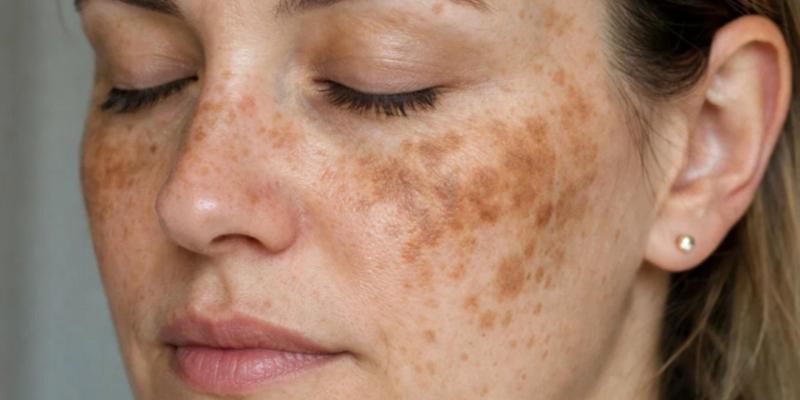
A patch of pigmentation can look deceptively simple. You notice a brown mark on your cheek, darker patches across your forehead or an uneven tone that seems more obvious after summer, and the natural assumption is that you simply need something to fade it.
In practice, pigmentation is rarely quite that straightforward.
Brown spots can develop for very different reasons. Some are the cumulative result of years of sun exposure. Others are driven by hormones, inflammation or previous acne. Melasma behaves differently again and has a tendency to return when its triggers are not properly controlled.
This distinction matters because hyperpigmentation is not a single condition. It is a broad term describing areas where the skin contains more pigment than the surrounding tissue. Treating every brown mark in the same way can lead to disappointing results and, in some cases, make pigmentation more noticeable.
At Dr Yusra Clinic, we therefore start by looking at what is causing the pigmentation, how the skin is behaving and how likely it is to produce further pigment before deciding how aggressively it should be treated.
What Is Hyperpigmentation?
Hyperpigmentation occurs when the skin produces or distributes excess melanin, the natural pigment responsible for skin, hair and eye colour.
Melanin itself is not a problem. It plays an important protective role in the skin. The issue arises when pigment production becomes uneven or remains elevated after a particular trigger. This can leave areas of the skin looking darker than the surrounding complexion.
Common examples include:
- sun spots and age spots
- melasma
- post-inflammatory hyperpigmentation after acne, irritation or injury
- uneven pigmentation following prolonged UV exposure
The face is particularly prone to pigmentation because it is repeatedly exposed to daylight, but pigmentation can also appear on the neck, décolletage, hands and other sun-exposed areas.
The first question is therefore not simply, “How do we remove this pigment?” It is, “Why is this pigment here?”
How Can You Tell the Difference Between Brown Spots, Melasma and Sun Damage?
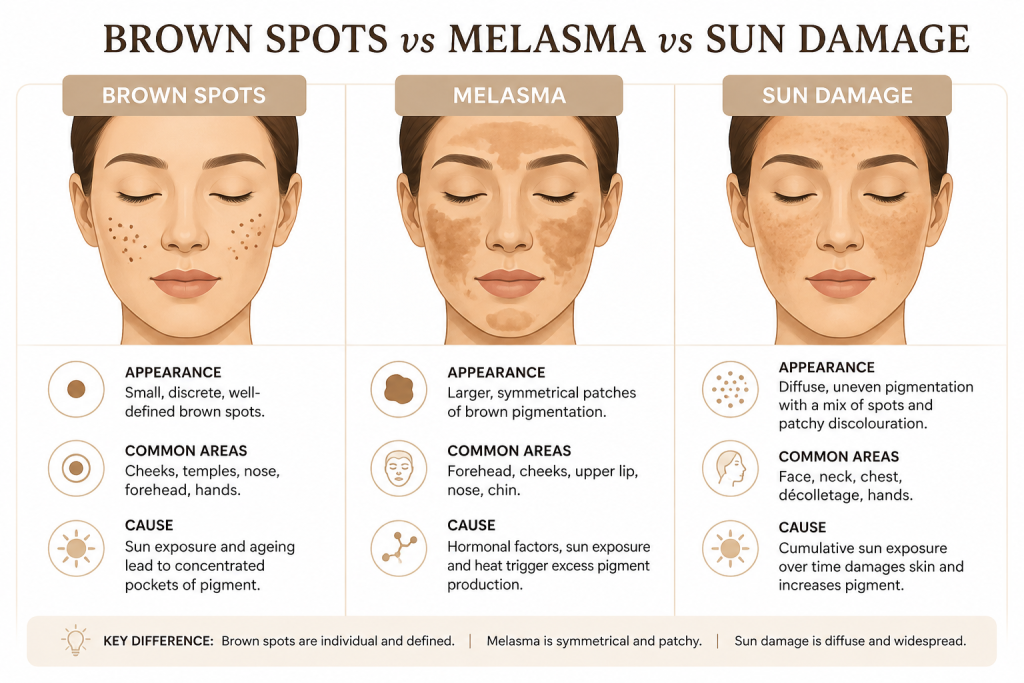
They can look similar in the mirror, but their behaviour often gives us useful clues.
Brown spots
Individual brown spots are often areas of concentrated pigment. They may become more noticeable with age, particularly after repeated sun exposure.
Rather than forming a broad patch, they tend to appear as more clearly defined areas of discolouration. Some people notice just one or two, while others gradually develop multiple spots across the face.
Not every brown lesion is cosmetic pigmentation, however. A new, changing, raised, irregular or otherwise concerning lesion should be medically assessed rather than automatically treated as a pigmentation problem.
Melasma
Melasma tends to create broader, more symmetrical areas of pigmentation, commonly across the cheeks, forehead, upper lip or central face. It is also more complex than an isolated sun spot.
Hormonal influences can play a role, which is why melasma may first become noticeable during pregnancy or alongside hormonal changes. UV exposure and visible light can also stimulate it.
One of the most important things we explain to patients is that melasma is usually managed rather than permanently “cured”. You can achieve a significant improvement, but the skin may remain predisposed to producing excess pigment.
This is why an aggressive approach is not necessarily a better one. Melasma requires careful pigment control and consistent maintenance.
Sun damage
Sun damage is usually more diffuse. Rather than one isolated patch, you may notice a combination of uneven pigmentation, scattered brown spots, dullness and changes in the overall quality of the skin.
Importantly, a tan fading does not mean the effects of UV exposure have disappeared. Pigment that has accumulated over time can become more noticeable once the surrounding tan settles.
Why Does Hyperpigmentation Keep Coming Back?
This is one of the most common frustrations we hear from patients. They improve the pigmentation, sometimes considerably, only to notice it gradually returning. The reason is that removing visible pigment does not necessarily remove the mechanism responsible for producing it.
Think of pigmentation as having two parts: the pigment you can already see and the tendency of the skin to create more of it.
If UV exposure, hormones, inflammation or another trigger continues stimulating pigment production, treating only the visible brown patches may give temporary improvement. This is particularly important with melasma. It is also why daily sun protection is part of pigmentation treatment rather than simply an optional skincare recommendation. Without controlling UV exposure, new pigmentation can develop while existing areas become darker again.
What Is the Best Treatment for Hyperpigmentation?
There is no single best treatment for every type of pigmentation. At Dr Yusra Clinic, the approach will depend on factors including the type and severity of pigmentation, your skin tone, sensitivity, previous treatments and whether the pigmentation is stable or still being actively triggered.
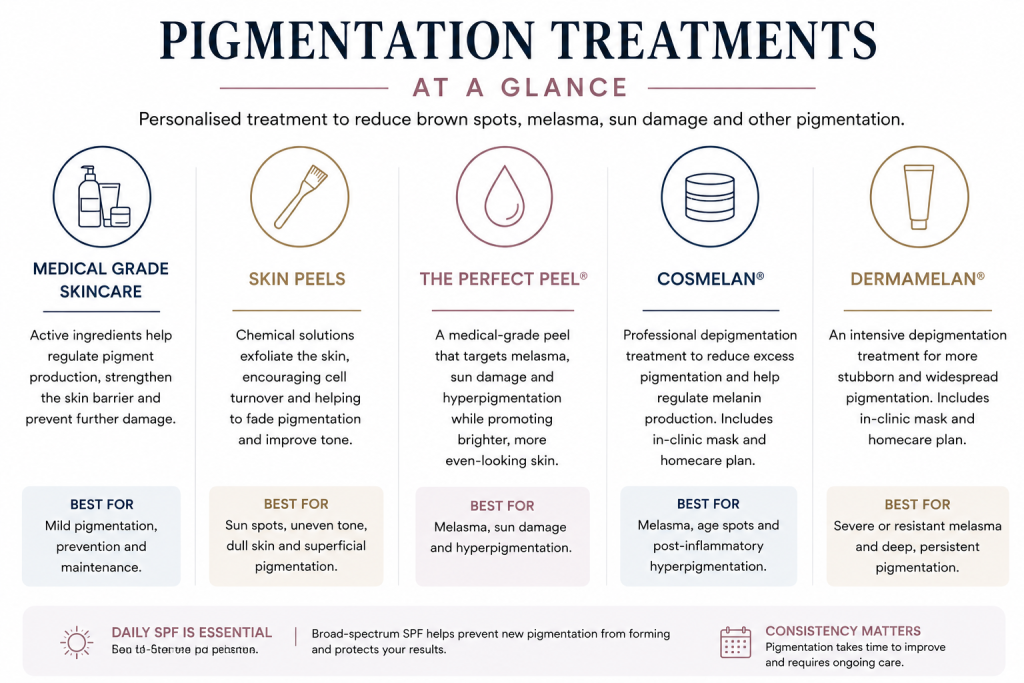
Milder pigmentation: Medical Grade Skincare may be used to help regulate pigment production and support a more even skin tone.
More established pigmentation: A Skin Peel may be introduced to encourage controlled skin renewal and improve visible discolouration.
Persistent melasma or resistant hyperpigmentation: Cosmelan or Dermamelan may be considered for a more targeted depigmentation approach.
The aim is not to choose the strongest treatment available. It is to choose the level of treatment your skin actually requires.
How Does Medical Grade Skincare Help Brown Spots and Uneven Skin Tone?
Skincare is often underestimated because results develop gradually, but it can be one of the most important parts of a successful pigmentation plan.
Professionally selected Medical Grade Skincare allows us to target several parts of the pigmentation process at once.
Depending on your skin, a programme may be designed to regulate pigment production, increase cell turnover, provide antioxidant protection and support the skin barrier.
Prescription-strength ingredients may also be considered where clinically appropriate. This can be particularly useful for early or mild hyperpigmentation, but skincare has another important role: preparing and maintaining the skin around professional treatment.
We often see patients who want to move immediately to a peel because the pigmentation is what they can see. If the skin is irritated, inflamed or poorly protected from UV, however, it can make more sense to stabilise the skin first.
Pigment-producing cells can respond to inflammation. Creating more irritation in an already reactive skin is rarely the best starting point.
Can Chemical Peels Remove Hyperpigmentation?
Chemical peels can be very useful when selected according to the patient’s skin type and the nature of the pigmentation.
A Skin Peel applies a controlled chemical solution to the skin to encourage exfoliation and renewal. As pigmented surface cells are shed and replaced, the complexion can gradually become brighter and more even.
Dr Yusra Clinic offers a range of peels at different depths, including Obagi Blue Peel Radiance. The right peel is selected according to your skin type, pigmentation and the level of correction required.
Someone with relatively mild, superficial pigmentation does not necessarily require the same peel as a patient with more established sun damage. Deeper is not automatically better, particularly in patients who are susceptible to post-inflammatory hyperpigmentation.
The Perfect Peel® is another option available at Dr Yusra Clinic and may be considered for concerns including melasma, sun damage and hyperpigmentation. It combines exfoliating ingredients to encourage skin renewal and a more even-looking complexion.
Visible peeling can occur after certain treatments, so timing and aftercare need to be considered carefully.
What Are Cosmelan and Dermamelan, and When Are They Used?
When pigmentation is persistent, widespread or behaving more like melasma, simply exfoliating the surface may not be enough.
This is where Cosmelan and Dermamelan become particularly relevant.
Cosmelan is a professional depigmentation treatment designed to reduce excess pigmentation while helping to regulate melanin production. Treatment involves an in-clinic mask followed by a structured homecare programme.
That second stage is important. Cosmelan is not simply a peel that is applied and forgotten about. The homecare phase continues to influence pigment production after the initial treatment.
Dermamelan follows a similar principle but is a more intensive depigmentation treatment. It may therefore be considered where hyperpigmentation is more severe, persistent or resistant. Both can be considered for concerns including melasma, age spots and post-inflammatory hyperpigmentation, but deciding between them requires proper assessment. With melasma especially, long-term control matters just as much as the initial improvement.
Should Melasma Be Treated Differently from Sun Spots?
A discrete area of sun-induced pigmentation and hormonally influenced melasma may both appear brown, but their biology and tendency to recur are different.
With melasma, we are generally thinking much more about controlling pigment activity over time. That can mean beginning with medical-grade skincare before progressing to a structured depigmentation programme such as Cosmelan or Dermamelan. Sun protection then remains essential after the visible pigmentation has improved.
For isolated sun damage, a carefully selected chemical peel may be appropriate where the pigment is relatively superficial. This distinction is one of the reasons diagnosing the pigmentation correctly is so important before beginning treatment.
Can You Combine Treatments for Hyperpigmentation?
Yes, and in many cases a carefully staged approach makes more sense than relying on one treatment alone. The important word is staged. Combination treatment does not mean performing everything at once. Pigmentation-prone skin needs enough time to recover between interventions, and unnecessary inflammation can work against what we are trying to achieve.
A treatment journey might begin with medical-grade skincare to improve skin condition and regulate pigmentation. Once the skin is stable, a suitable peel may be introduced to address more visible discolouration.
For more persistent melasma or resistant pigmentation, we may instead progress towards Cosmelan or Dermamelan, followed by an appropriate maintenance routine.
The sequence will depend on the individual skin rather than following a standard package.
Why Does SPF Matter So Much When Treating Pigmentation?
You can invest in an excellent pigmentation treatment and undermine the result surprisingly quickly through repeated unprotected sun exposure. UV radiation stimulates melanin production, which can darken existing pigmentation and contribute to new areas developing.
For patients with melasma, protection is particularly important because the skin already has a tendency towards excessive pigment activity. Broad-spectrum SPF should therefore be used consistently, including after your pigmentation has improved.
It is not simply about protecting the result of treatment. It is part of the treatment itself.
Frequently Asked Questions About Hyperpigmentation
Can hyperpigmentation get darker before it gets lighter?
Depending on the treatment, pigmentation can temporarily appear darker as pigmented cells move towards the surface and the skin renews. Your practitioner should explain what to expect from the specific treatment recommended for you.
Why do I have pigmentation on my upper lip?
Upper-lip pigmentation can have several causes, including melasma and post-inflammatory pigmentation. Because the causes differ, it is worth having the area assessed before attempting to treat it.
Can acne leave permanent brown marks?
Acne commonly leaves post-inflammatory hyperpigmentation, particularly in skin that produces pigment readily after inflammation. These marks may gradually fade, although persistent pigmentation can benefit from targeted treatment.
Can hyperpigmentation affect darker skin tones?
Yes. In fact, darker skin tones can be particularly prone to post-inflammatory hyperpigmentation because melanocytes are more active. Treatment needs to be selected carefully to improve pigment without creating unnecessary inflammation.
Does fake tan make hyperpigmentation worse?
Self-tanning products do not expose the skin to UV in the way that natural tanning or sunbeds do. However, they also do not protect against UV radiation, so daily sun protection remains necessary.
Should I stop using retinol before a pigmentation treatment?
Potentially. Some active skincare ingredients need to be paused before particular peels or depigmentation treatments. You will be given specific instructions based on your existing routine and planned treatment rather than a generic rule.
Taking the Next Step
Pigmentation treatment works best when we stop treating every brown mark as the same problem. At Dr Yusra Clinic, the first step is to establish whether you are dealing with melasma, sun damage, post-inflammatory hyperpigmentation or another form of uneven pigmentation. From there, treatment can be planned around how your skin actually behaves, using options such as Medical Grade Skincare, Skin Peels, The Perfect Peel®, Cosmelan or Dermamelan where appropriate. The goal is not simply to lighten what you can see today. It is to improve skin clarity while reducing the factors that allow pigmentation to keep returning.
If brown spots, melasma, sun damage or persistent hyperpigmentation are concerning you, you can book a consultation at Dr Yusra Clinic in London, Liverpool or Manchester to have your skin assessed and discuss the most appropriate way forward.

Dr Yusra Al-Mukhtar
Dr Yusra is a distinguished dental surgeon and a skilled medical aesthetic clinician with a wealth of experience in maxillofacial head and neck surgery and skin cancer surgery. She holds an impressive academic background, having graduated with first-class honours in Medical Science and Healthcare Management from Imperial College London and earned Honours and Distinction as a dental surgeon from King’s College London.Dr Yusra is a Level 7 Trainer in medical aesthetics, in line with Ofqual guidelines, and is renowned for her expertise in providing natural-looking non-surgical facelifts and a range of aesthetic treatments. Her commitment to patient well-being and safety is unwavering, making her a trusted practitioner in the field.