Endolift vs FaceTite: Which Skin Tightening Treatment Is Better?
Posted on 10th August 2026 by Dr Yusra Al-Mukhtar

Endolift is an advanced laser treatment that tightens loose skin, improves jawline definition and stimulates your body’s natural collagen production. It has become an increasingly popular option for patients looking to achieve noticeable facial rejuvenation without the downtime associated with a traditional facelift.
If you’ve been researching Endolift, you’ve probably also come across FaceTite. While both treatments are designed to tighten the skin and improve facial contours, they work in different ways and are suited to different patients.
This guide explains how Endolift compares with FaceTite, who each treatment is best suited to and why at Dr Yusra Clinic, Endolift is our preferred option for patients with early skin laxity and jowl formation.
Why Does Facial Skin Become Loose?
Understanding why the face changes with age helps explain why treatments such as Endolift and FaceTite can be so effective.
As we get older, our natural collagen and elastin production gradually slows. These proteins provide the skin with its strength, firmness and elasticity. At the same time, the supporting structures beneath the skin begin to weaken, while small changes in facial fat distribution can contribute to a softer jawline and early jowl formation.
Skin laxity can also develop following significant weight loss, including after GLP-1 weight loss medications such as Ozempic or Mounjaro, when the skin does not fully contract around the new facial contours.
Patients commonly notice:
- Mild skin laxity
- Early jowls
- Reduced jawline definition
- Loose skin beneath the chin
- Small pockets of stubborn fat
- A less defined lower face
These changes develop gradually, which is why many patients seek treatment before considering surgery. When addressed early, collagen-stimulating procedures can often improve skin firmness and facial definition without the need for a facelift.
What Is Endolift?
Endolift is a minimally invasive laser treatment that tightens the skin from within while stimulating the body’s natural collagen production.
Using an ultra-fine optical fibre inserted beneath the skin, laser energy is delivered directly into targeted areas of the face. This controlled energy contracts existing collagen fibres, stimulates the production of new collagen and can also reduce small, localised pockets of fat.
Unlike treatments that work from the skin’s surface, Endolift treats the deeper supporting tissues responsible for skin laxity and facial definition.
It is commonly used to improve:
- Early jowls
- Jawline definition
- Mild neck laxity
- Loose skin beneath the chin
- Lower face contour
- Small pockets of unwanted facial fat
One of the reasons Endolift has become increasingly popular is its precision. The fine laser fibre allows the practitioner to treat very specific areas while minimising disruption to the surrounding tissues.
What Does Endolift Treat?
Endolift is designed to improve the early signs of facial ageing by tightening loose skin, stimulating collagen production and refining facial contours. It is particularly effective for patients who want noticeable rejuvenation without undergoing surgery.
Depending on your individual concerns, Endolift can be used to treat:
- Early jowls
- Loose skin around the jawline
- Reduced jawline definition
- Mild skin laxity of the lower face
- Loose skin beneath the chin
- Small, localised pockets of facial fat
- Early neck laxity
- Early signs of facial ageing, including after significant weight loss
Rather than simply tightening the skin, Endolift works beneath the surface to improve the deeper supporting tissues. This allows it to create firmer, more defined facial contours while maintaining natural facial movement and expression.
Endolift works very well with ULTRAcel, to address skin laxity, collagen loss and facial contouring without surgery. Click here to discover the benefits of combining these advanced technologies and why a personalised treatment plan can often achieve better results than either treatment alone.
As with any aesthetic treatment, the areas treated and the results achieved will depend on your facial anatomy, skin quality and individual treatment goals.
What Is FaceTite?
FaceTite is another minimally invasive facial tightening treatment, but instead of laser energy it uses radiofrequency-assisted lipolysis (RFAL).
The procedure uses an internal probe beneath the skin and an external electrode on the surface. As the probe is bigger, an incision is needed which is then sutured after treatment. Sutures can be dissolvable or removable. Radiofrequency energy passes between the two, heating the tissues to tighten the skin while helping to break down unwanted fat.
FaceTite is often recommended for patients with:
- Moderate skin laxity
- Larger areas of facial fat
- Lower face and neck contouring concerns
- More advanced jowls
Because it generally treats a broader area and is frequently combined with liposuction, recovery tends to be significantly longer than with Endolift.
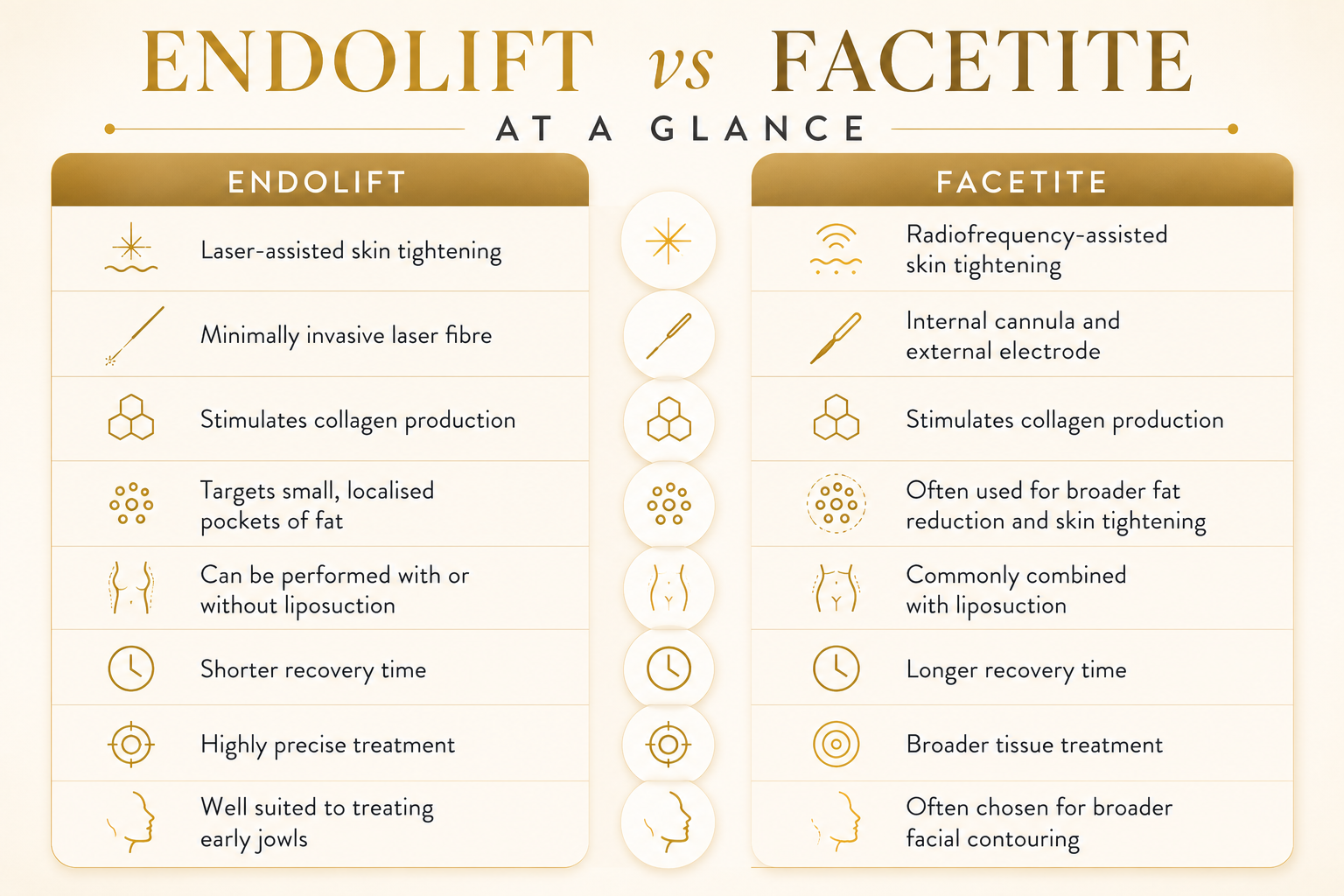
Both treatments stimulate collagen and improve facial contours, but Endolift uses more precision heating with a finer fibre optic and without incisions or sutures, whilst Facetite uses a larger probe and has more downtime. The difference is in different technologies and treatment techniques.
Endolift vs FaceTite: What’s the Difference?
Although Endolift and FaceTite are often grouped together as minimally invasive skin tightening treatments, there are several important differences that influence which procedure is most appropriate.
Technology
The most obvious difference is the energy source.
Endolift uses laser energy delivered through an ultra-fine optical fibre, allowing highly targeted treatment beneath the skin.
FaceTite uses radiofrequency energy delivered between an internal probe and an external electrode, creating a larger treatment zone.
Both technologies stimulate collagen, but they do so in different ways.
Precision
Precision is one of Endolift’s biggest advantages.
Because the laser fibre is extremely fine, treatment can be directed exactly where it is needed. This makes it particularly effective for refining the jawline, treating early jowls and targeting small areas of unwanted fat without affecting the surrounding tissues.
This level of control is one of the main reasons Dr Yusra often recommends Endolift for patients with mild to moderate concerns.
Fat Reduction
Both treatments can address unwanted facial fat, but they are designed for slightly different situations.
Endolift is particularly effective for small, localised pockets of fat, especially beneath the chin and around the jawline. Depending on the patient’s anatomy, it can be performed either as a standalone procedure or alongside liposuction.
FaceTite is more commonly used when larger areas of fat reduction are required and is frequently combined with liposuction as part of the treatment.
Downtime
Recovery is another major difference.
Because Endolift is less invasive and causes less disruption to the surrounding tissues, patients generally experience less swelling and bruising than they would after FaceTite.
Although every patient heals differently, many people choose Endolift because it offers meaningful skin tightening with a significantly shorter recovery period.
Endolift Results: When Will You See an Improvement?
One of the benefits of Endolift is that improvements develop both immediately and progressively.
Patients may notice an initial improvement in skin tightness once early swelling settles. However, the most significant changes occur over the following months as new collagen forms and the skin continues to remodel naturally.
Because collagen production is a gradual biological process, results continue to develop over time, producing a refreshed and natural-looking appearance rather than an abrupt change.
Can Endolift Replace a Facelift?
This is one of the most common questions we hear in clinic. The answer depends entirely on the degree of skin laxity.
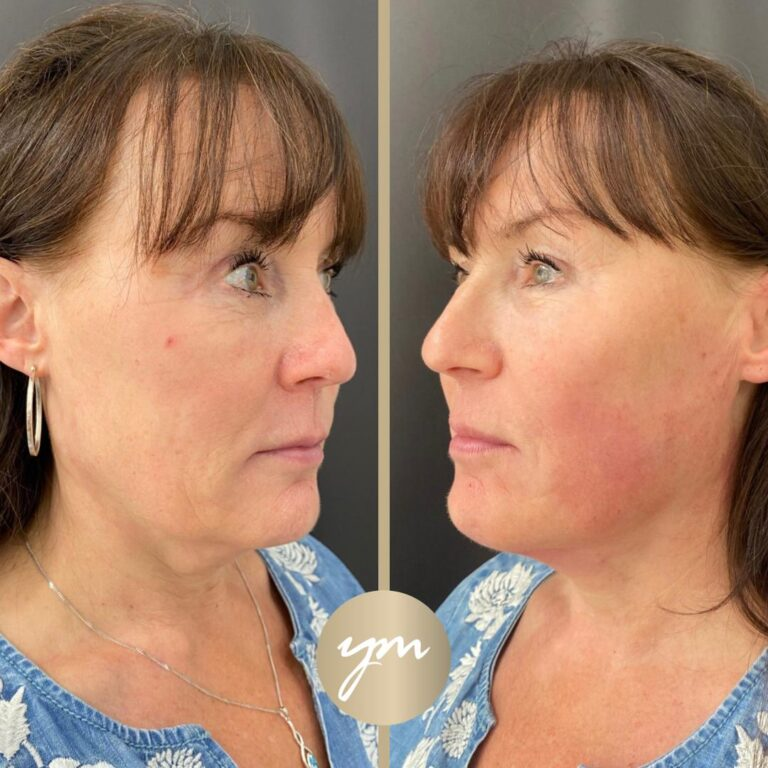
For patients with early to moderate signs of ageing, Endolift can provide impressive improvements in skin firmness and facial definition while avoiding the recovery associated with surgery.
However, it cannot remove large amounts of excess skin or reposition deeper facial tissues in the way that a surgical facelift can.
Rather than viewing Endolift as a replacement for surgery, it is more accurate to think of it as an effective option for patients who want meaningful rejuvenation before surgical intervention becomes necessary.
Is Endolift Safe?
When performed by an experienced medical practitioner, Endolift is considered a safe and well-established treatment.
As with any medical procedure, temporary side effects such as swelling, bruising, tenderness and redness can occur. More significant complications are uncommon but highlight the importance of choosing a practitioner with an in-depth understanding of facial anatomy, laser technology and aesthetic medicine.
Careful patient selection is equally important. Not every patient is an ideal candidate for Endolift, and recommending an alternative treatment when appropriate is part of responsible clinical practice.
Frequently Asked Questions
Is Endolift better than FaceTite?
Neither treatment is universally better. Endolift is often preferred for patients with mild to moderate skin laxity because it offers highly precise treatment, shorter downtime and excellent results for early jowls and jawline definition. FaceTite may be more appropriate when broader contouring or larger areas of fat reduction are required.
How long do Endolift results last?
Results vary between patients, but improvements are long-lasting because Endolift stimulates new collagen production. While the natural ageing process continues, maintaining a healthy lifestyle and good skincare routine can help support your results.
Does Endolift really work?
Yes. Endolift works by tightening existing collagen fibres while stimulating the body’s natural production of new collagen. Patients typically notice improvements in skin firmness, facial definition and mild skin laxity that continue to develop over several months.
Is Endolift painful?
The treatment is usually performed using local anaesthetic where required, making it well tolerated by most patients. Some tenderness and swelling afterwards are normal but generally settle as the skin heals.
Can Endolift treat jowls?
Yes. Endolift is particularly effective for early jowls, helping tighten loose skin and improve jawline definition while also reducing small pockets of fat when appropriate.
Is there any downtime after Endolift?
Yes, although downtime is generally shorter than with FaceTite. Most patients experience mild swelling and bruising that gradually improves over the following days.
Can Endolift be combined with liposuction?
Yes. Depending on the patient’s anatomy and treatment goals, Endolift can be performed either as a standalone procedure or alongside liposuction to enhance facial contouring.
Considering Endolift?
If you’re beginning to notice early jowls, reduced jawline definition or mild skin laxity, a consultation is the best way to determine whether Endolift is the right treatment for you.
At Dr Yusra Clinic, every treatment begins with a detailed assessment of your facial anatomy, skin quality and long-term goals. Rather than recommending a one-size-fits-all solution, Dr Yusra creates personalised treatment plans designed to achieve natural, balanced results that enhance your features rather than change them.
Recognised by Tatler and trusted by patients across London, Liverpool and Manchester, Dr Yusra combines advanced technology with a medically led approach to deliver refined, natural-looking facial rejuvenation.
Book a consultation to find out whether Endolift is the most suitable treatment for your concerns. A personalised assessment is the best way to determine the safest and most effective approach for your skin, anatomy and aesthetic goals.

Dr Yusra Al-Mukhtar
Dr Yusra is a distinguished dental surgeon and a skilled medical aesthetic clinician with a wealth of experience in maxillofacial head and neck surgery and skin cancer surgery. She holds an impressive academic background, having graduated with first-class honours in Medical Science and Healthcare Management from Imperial College London and earned Honours and Distinction as a dental surgeon from King’s College London.Dr Yusra is a Level 7 Trainer in medical aesthetics, in line with Ofqual guidelines, and is renowned for her expertise in providing natural-looking non-surgical facelifts and a range of aesthetic treatments. Her commitment to patient well-being and safety is unwavering, making her a trusted practitioner in the field.